Map the response
Use TMS as a controlled intervention and fMRI to measure local and remote network responses.
Explore the methodMARTIN TIK · NEUROSCIENCE · VIENNA
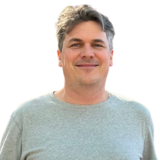
I’m Martin Tik, a neuroscientist at the Medical University of Vienna. I study how brain networks respond to stimulation, with a particular interest in what this can teach us about depression.
CURIOSITY & PURPOSE
I have always wanted to understand how the brain makes us who we are: how a thought takes shape, why an idea suddenly clicks, and how our experience of the world can change.
Depression makes those questions deeply personal. I know how profoundly it can touch a life, and the lives around it. That gives my research a sense of urgency: better understanding should ultimately help create better possibilities for people who need them.
My contribution is to connect brain imaging with stimulation. I want to understand what an intervention actually does to a person’s brain networks, so that future approaches can be informed by more than where we place a stimulation target.
TMS-fMRI · NETWORKS · TIMING
In the Tik Group, I bring together my background in psychology and medical physics. Our central method is concurrent TMS-fMRI: combining transcranial magnetic stimulation with functional MRI to investigate how a targeted intervention affects the wider brain.
The long-term motivation is better-informed brain stimulation for depression. Our experiments investigate mechanisms and target engagement—essential steps toward that goal.
Use TMS as a controlled intervention and fMRI to measure local and remote network responses.
Explore the methodInvestigate how the target, stimulation intensity and brain state shape individual responses.
Explore the methodTime stimulation relative to a task to investigate state-dependent network effects, including language production.
Explore the methodExplore the distinction between observing functional connectivity, mapping a stimulation response and changing the timing of an intervention.
My background in psychology and medical physics shapes how I approach this question: connect the cognitive process, the intervention and the response of the whole network. My work spans interleaved TMS-fMRI, individual target engagement and chronometric approaches to cognition.
Nolan was my mentor. I will always be grateful for his trust, his generosity, and the opportunity to work with him at Stanford. His commitment to people living with depression continues to shape why this work matters to me.
Our collaboration with the Stanford Brain Stimulation Lab connects that motivation to a practical question: how can we measure the brain’s response while delivering stimulation? Our shared work on interleaved TMS-fMRI and theta-burst stimulation is part of that effort.
Our Stanford collaborationFROM THE LAB & BEYOND
A few recent moments of exchange, teaching and building methods together.
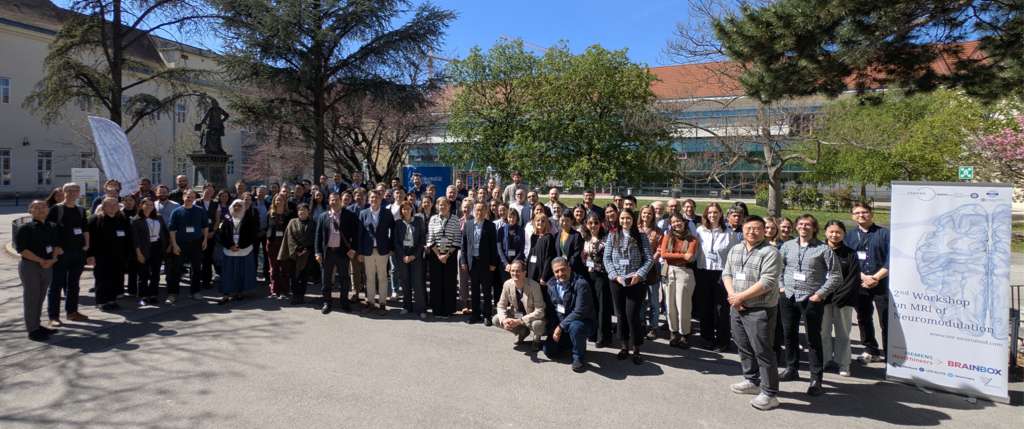
Our group hosted and locally organised the 2nd Workshop on MRI of Neuromodulation on 7–9 April 2026. As host and co-chair, I helped bring together the people developing methods to understand stimulation, target engagement and brain networks.
Workshop & programme18 September 2026 · Vienna
At the EPICONN retreat, I presented how interleaved TMS-fMRI helps us move from observing network relationships to testing responses to a controlled intervention.
EPICONN & group news23–28 May 2026 · Aalto
Teaching at the TMS–EEG Summer School and Workshop was a chance to discuss interleaved and chronometric TMS-fMRI with the next generation of researchers.
Teaching & event detailsJanuary–February 2026 · Hong Kong
I returned to PolyU for hands-on exchange with Georg Kranz and colleagues, building on our work integrating TMS, fMRI and fNIRS.
The Hong Kong collaborationMEDIA & PUBLIC ENGAGEMENT
From the sudden joy of an Aha! moment to explaining the brain on television: I enjoy bringing questions from the lab into everyday conversation.
Explore media, talks & the Aha! storySelected coverage of our Aha! research
New Scientist
ORF Science
Medical Xpress
RESEARCH HIGHLIGHTS
A few contributions that capture the direction of my research. The group website brings together the wider publication record and student projects.
FROM PSYCHOLOGY TO IMAGING STIMULATION
2014 · UNIVERSITY OF VIENNA
“Motivation is what keeps us alive.” That was the opening of my psychology diploma thesis. I investigated how repetitive TMS of the left DLPFC affected reward anticipation in smokers, using fMRI before and after stimulation.
Read the abstract ↗2019 · MEDICAL UNIVERSITY OF VIENNA
My doctoral thesis brought together functional targeting, network changes after TMS and imaging during stimulation. The question connecting these studies still guides my work: what does stimulation actually do to the brain?
Explore the doctoral thesis ↗Today, these questions guide our work in the Tik Group. Explore how we use MRI before, after and during TMS.
TIK GROUP · VIENNA
I lead the Tik Group in Vienna. If you are a student looking for a thesis, a researcher interested in TMS-fMRI, or a potential collaborator with a question we could tackle together, I would like to hear from you.
COMMUNITY
Close partnerships with Anna-Lisa Schuler, the Stanford Brain Stimulation Lab, and the independent research groups led by Lena Nohava and Michael Woletz are central to our work. Further collaborations connect Vienna with Hong Kong, Toronto, Munich and Melbourne.
Meet our scientific partnersCONTACT
For scientific collaborations, talks and research enquiries, the best way to reach me is by email.
martin.tik@meduniwien.ac.atMedical University of Vienna
Center for Medical Physics and Biomedical Engineering
MR Physics Division
These downloadable documents are older versions. For my current research and roles, see this page and my institutional profiles.
CV · archive, 2024 file NIH biosketch · January 2023